lipu pi sona wiki
THIS SITE IS OUTDATED
This page was made by two_squared (jan Tu Leko) in carrd.co. (find out more info about him on squared.straw.page. If I ever get a place to publish Toki Pawole stuff to the internet, then all this info will probably move somewhere else.Toki Pawole is my conlang and tokiponido, made for international communication. lipu pi sona wiki is an online source for how to read and construct Toki Pawole sentences quickly for yourself. Learn more about Toki Pawole here.toki! lipu sisanti ni e ilo pona u sona e kanun pi toki pawole. toki pawole e toki epiku ajela a!It’s ok if you didn’t understand half of that. I was just speaking Toki Pawole, the language of infinity. lipu sona wiki is here to teach you the simple grammar of Toki Pawole quickly, in 20 simple steps.Beginner
0. speak it
1. li & e
2. modifiers
3. modifiers 2
4. questions
5. contextIntermediate
6. body parts & sensory
7. tokipawolization
8. vocab
9. preverbs
10. prepositions
11. compound sentences
🔏 12. situations and activitiesAdvanced
🔒 13. te & u
🔒 14. vocab 2
🔒 15. writing
🔒 16. numbers
🔒 17. recap
🔒 18. translationExtra!
🔒 19. writing & input systems
🔒 20. texts
Step 0: speak itToki Pawole is very different from English. In English words that are spelled similarly may be pronounced differently like, “through,” “thorough,” and “throughout,” but in Toki Pawole, words like isala, jala and kala are all pronounced similarly, because they are spelled the same.This is because in Toki Pawole, every letter can only be pronounced one way. There are strict rules for how letters can be put together, and for how they can be stressed and written. Let’s start with writing.
Toki Pawole has 14 letters.Consonants:
j, k, l, m, n, p, s, t, wVowels:
a, e, i, o, uTo write Toki Pawole using the latin alphabet, (which is also what this course is written in), you use these 14 letters. Each letter corresponds to 1 sound, and it is written left to right like English.To end sentences, you use a period, or an exclamation point. If the sentence is a question, you end it with a question mark. There are specific situations that determine whether a sentence is a question or not, which we go over in step 4.toki! mi e jan tu leko! mi li sota ita mi li wilen moku.We’re on the right track. You might notice that toki, mi and mi aren’t capitalized at the beginning of the sentence. This is because only proper names are capitalized. Pronunciation also doesn’t change when words are capitalized.toki! mi e jan Tu Leko! mi li sota ita mi li wilen moku.Commas can go after repeated sections using en, li (and its forms) or e. The commas go before each of these particles, so this would be correct:mi, en si, en on e pona, li tawa, li tawa ki poki moku, li sota, li weka.And this would be wrong:mi en, si en, on e pona li, tawa li, tawa ki poki moku li, sota li, weka.Commas also go before/after clauses, which we go over in step 5. Unlike repeated sections, there is no “correct way” to put the commas. This is correct (pay attention to ita):toki! mi e jan Tu Leko! mi li sota, ita mi li wilen moku.And this is also correct:toki! mi e jan Tu Leko! mi li sota ita, mi li wilen moku.Colons are a special one. They’re only used in the specific niche situation of ni clauses, which almost never happen. If you’re introducing a relative clause with ni, you use this.mi li pali e ni: si li pilin nasa.Finally, pi and i can be replaced with opening and closing brackets “[“ “]”, and pin and ini can be replaced with opening and closing quotation marks, but I don't recommend either of these.Oh yeah and newlines signify paragraph breaks. Now that we’re done with writing, let’s move on to pronounciation.In Toki Pawole, letters are only pronounced one way, like in the IPA. If you’re not familiar with the IPA, then good… this section is for you. If you are familiar with the IPA, then you can skip to stress patterns.Consonants:
j, k, l, m, n, p, s, t, wVowels:
a, e, i, o, up, t, k, w, s, m and n are pronounced similarly to how they are in English. The tricy one is j. j is pronounced “y” like Nordic languages and German. The vowels are pronounced much differently. When I am talking about these vowels, the first example is General American English and the second example is British English received pronunciation. If you don’t speakeither of these dialects, look up the pronounciation on Wikipedia.a - claw / father
e - play / dress
i - ski / fleece
o - road / orange
u - glue / gooseIf there are some sounds you can’t pronounce, you can tweak the pronunciation to fit to the language you are used to. For example, Russian doesn’t have the /w/ sound, so it is perfectly understandable if Russian speakers pronounce /w/ like /v/.Now onto syllables. Toki Pawole has a restrictive syllable structure, which means the way you put sounds together has a specific method. Toki Pawole syllables are made like (C)V(N), with an optional starting consonant, a mandatory* vowel, and an optional ending nasal (the letter n).Syllables that don’t have a starting consonant have to go at the beginning of the word. Syllables that have an ending nasal can’t go before syllables that have a starting m or n. Syllables can’t have wu or ji. All of these would be too hard to pronounce.Examples of words that break these rules would be:taan - Breaks the “syllables that don’t have a starting consonant have to go at the beginning of the word” rule.lemnon - Breaks the “syllables that have an ending nasal can’t go before syllables that have a starting m or n” rule.wunjitu - Breaks the “syllables can’t have wu or ji” rule.*The only exception to the mandatory vowel rule is the word n.Stress goes on the first syllable of every word. Stress is the difference between “object” as in “Hand me that object.” or “object” as in “Your honor I object.” Syllables with stress sound bigger, more open and more pronounced.(If you’re used to tonal languages, a rising tone is applied on the first syllable of every word.)Stress is important in Toki Pawole. These two sentences sound similar without stress, but are different because of stress.on e suli.
/ˈon.ˈeˈsuli/
They are big.one suli
/ˈoneˈsuli/
Big weakness.Another difference between the two is Sandhi. Sandhi are changes that happen between word borders. It varies between hypothetical Toki Pawole dialects, but in my dialect (the only one), glottal stops happen between words. A glottal stop is the “-” in “uh-oh.” It makes it so there’s a break between on and e, instead of just running them together.Another form of Sandhi is the nasal ending syllables. If a syllable ends with n, like tan, if the next word starts with a p, like pona or w, like wawa, you are allowed to pronounce the n like m.tan pona
/ˈtamˈpona/
From good.tan wawa
/ˈtamˈwawa/
From power.The same applies to “n j” (you are allowed to palatalize n) and “n k” (you can pronounce the n like ng).See if you can pronounce these sentences and words correctly:pona.sina e ike.mi li tawa ki soko.jan pi moku li lanwano tan si e moku.waleja.toki! mi e jan Tu Leko! mi li sota ita, mi li wilen moku.About the formatting of this site:
Toki Pawole text is put in italics. English words and translations are not formatted. Examples of English words are put in “quotes.” Pronunciations are put in /slæʃes/ (slashes). Important new concepts are colored, or they could be highlighted. Headings are bolded. For content words, their gloss is put in ALL CAPS. Particles are usually lowercase with a period. or have some symbol →. Pronouns are surrounded by {braces}, unless they’re being used as modifiers, and [brackets] signify modifier groupings. (parenths) are used to show the forms or action of a word.→ Next step
← Previous step
⇄ Back to front page
Step 1: li & eNow that we’re done with that silly pronunciation stuff, (that speakers of toki pona probably already know), I bet you’re wondering how you actually make sentences.A statement is the type of sentence we’ll learn about how to make in this step. A statement conveys info as its primary goal. This entire step so far is entirely statements. Statements in Toki Pawole end in periods and exclamation points.The first way to create a statement is with e. e in Toki Pawole is something called a copula. Copulae are commonly found in central to west european languages, and English has them too. Copulae connect the subject and the predicate, like the words “is,” “was,” “were” and “are” do in English. The subject is what the sentence is talking about, and the predicate is what the subject is doing.To clarify, here’s the example sentence “I am eating a sandwich.” In this sentence, “I” is the subject, because it’s what the sentence is talking about, “am” is the copula, because it connects the subject and the predicate, and “eating a sandwich” is the predicate, because it is what the subject is doing.Time for some vocab. You already know e, but what about mi (me), si (you), on (third person singular pronoun, he she), toki (communication, speak, say, talk), pona (good), ike (bad), moku (food), pali (do, make, create), ijo (thing, object, something) and sota (eat, wrap).You can look up their exact definitions on tana intawo, but the words in the parentheses should give you a rough translation on what they mean. sona wiki is more focused on the grammar and not the vocab.Now that you know all this… what do you think mi e pona means?mi e pona.
{1SG} is. GOOD
I am good.The subject here is colored red, and the predicate is colored blue. Yeah see? Simple so far, for the most part. These type of sentences are called “e sentences” and e followed by a predicate is called an “e phrase.”si e mi.
{2SG} is. {1SG}
You are me.pona e pona. ike e ike.
GOOD is. GOOD. BAD is. BAD
Good is good. Bad is bad.mi e pali.
{1SG} is. MAKE
I am creating.****
Wait, that has an asterisk. Why does that have an asterisk?There only so far you can get with e. The difference between e and “is” is that verbs can come after “is,” “He is eating.” but verbs can’t come after e, only nouns and adjectives can do that. mi e pali doesn’t mean “I am creating,” it means “I am creation” or “I have attributes of creation.”To say something “is DOING” something else, you use the word li. li means something closer to “does” in English. It is used to introduce verbs.mi li pali.
{1SG} does. MAKE
I am creating.mi li sota.
{1SG} does. EAT
I am eating.In Toki Pawole, words don’t decline. That is they don’t change pronunciation based on the things around it. Like how in “I am eating,” “You are eating,” and “He is eating,” “am,” “are,” and “is” all mean the same thing here, they’re just declined to match with the subject. Toki Pawole doesn’t do that. Every word always stays the same when it means the same.Toki Pawole also doesn’t have the words “the” and “a,” unlike English. You just don’t need them.Oh yeah and about on. You might not understand what “third person singular pronoun” means. You know first person shooters, in which you’re acting as the person in the game? If I were playing the game, the person in the game would be me. In third person shooters there’s a little camera behind the person in the game, as if the person in the game is a different person. Third person refers to not you, not me, but them. A person that isn’t the person speaking, or the one being addressed. They are a third person. Singular just means you’re speaking to one singular person. on works like the singular “they.”li has forms. eki is for things that happen in the future:mi eki sota.
{1SG} is. EAT(future)
I will eat.And eta is for things that happened in the past.mi eta sota.
{1SG} is. EAT(past)
I have eaten.li could take place at any time (but it usually means the present.) These sentences that use li, eki or eta are called “li sentences” and li followed by a predicate is called an “li phrase.”You can use li and e together to make more complicated sentences, too. The object is what the subject is affecting. In “I am eating a sandwich,” “a sandwich” is the object, because it is what the subject is affecting. You can do this in Toki Pawole too.mi li sota e moku.
{1SG} is. EAT obj. FOOD
I am eating food.By putting li with e, you create a transitive sentence. This means that the verb turns transitive. Transitive verbs are verbs that affect objects. “Exist” is always intransitive (which means it can’t affect objects), “chase” is usually transitive (You usually chase things, not just say “I chase.”) and “walk” can be both transitive and intransitive. (“I walk.” vs “I walk my dog.”)mi li pali e ijo.
{1SG} does. MAKEt obj. THING
I am making something.on li toki e si.
{3SG} does. SPEAKt obj. {2SG}
They are causing you to speak.on li pona e ijo.
{3SG} does. GOODt obj. {2SG}
They are fixing the thing.pona in the verb section means something like “fix,” and ike in the verb section means something like “worsen.” Adjectives and nouns after li turn into verbs, and verbs after e turn into nouns.This should be it for this step. See if you can decipher the meaning of these sentences without clicking the spoilers. If you can’t, click on the center gloss. If you still can’t, click on the answer, and see if you can learn a thing or two.on eta pali.
Content Words learned: mi, si, on, toki, pona, ike, moku, pali, ijo, sota.→ Next step
← Previous step
⇄ Back to front page
Step 2: modifiersModifiers are words, and their main goal is to apply attributes or qualities to another word, called the head word. In the sentence “I saw the red ball,” “red” would be a modifier, because it is applying an attribute or quality to “ball,” which is the head word. In “I quickly ran to the door,” “quickly” is also modifying “ran.”Unlike English, Toki Pawole has modifiers primarily come after the head word. Instead of “red ball,” you would say “ball red.” One of the ways you can apply modifiers is by using pronouns. mi, si and on can come after things to show ownership, for example. This is called possessiveness.ijo mi
[[THING] 1SG POSS]
My thingijo si
[[THING] 2SG POSS]
Your thingijo on
[[THING] 3SG POSS]
Their thingWith that, we can introduce some vocab!kalama means (sound), along with soweli (animal, but specifically mammals that are hairy and walk on 4 legs), ilo (tool), mute (many), wolin (love), tawa (move, walk, fly, go), lansan (slow), wiki (fast), jan (person), suli (big), lili (small), pawole (infinite)Woah, that’s a lot. Again, you can look up their exact definitions on tana intawo, but the words in the parentheses should give you a rough translation on what they mean.Anyway, not just pronouns can be used as modifiers. You can use any content word as a modifier. A content word is a word with meaning, unlike particles which are just there to structure the sentences. (Head words are in bright orange, modifiers are in darker orange.)tawa wiki
[[MOVE] FAST]
Move fast.
Run.
Fly fast.
Dash.
Move early.All of those are possible translations of tawa wiki. In Toki Pawole, words are vague. They can mean multiple things, and it depends on context. However, 2 word modifier phrases like thse tend to be lexicalized. Lexicalization is when 2 or more words get a fixed meaning attached to them, and they can’t mean anything else. An example of lexicalization is “high school.” It can only refer to a school that comprises of grades 9-12, and not a school that is high up. If you say “high school” then people will think you’re talking about the first example, not the second one.toki pona tends to avoid lexicalizations, but Toki Pawole says, “whatever makes communication easier.” In my opinion, tawa wiki means run, and if you’re talking to me, just know that’s how I’ll interpret it.Now back to modifiers. What do you think this sentence means WITHOUT looking at the spoiler. If you can’t, click on the center gloss. If you still can’t, click on the answer, and see if you can learn a thing or two. Here, to help i’ll color it corresponding to parts of speech.soweli on li pali e ilo pona.
[[ANIMAL] 3SG POSS] pred, CREATEt obj. [[TOOL] GOOD]
Their animal creates a good tool.Time to introduce another particle! Well almost. jo is a particle and a content word. As a particle, it means “owned by.”kalama jo soweli mi
SOUND owned. [[ANIMAL] 1SG POSS]
Sound, that is owned by my animal.As a verb, it means “own, have, or contain.”jan li jo e ilo si.
PERSON pred. OWN obj. [[TOOL] 2SG]
The person has your tool.Here’s a new pronoun, ni. ni means “this,” or “that.”soweli ni
[[ANIMAL] THIS]
This animallansan ni
[[SLOW] THIS]
That slownessIt can also work as a regular pronoun.ni li sota e moku si.
THIS pred. EAT obj. [[FOOD] 2SG POSS]
This is eating your food.That’s it for this step. See if you can decipher the meaning of these sentences without clicking the spoilers.soweli wiki
Content Words learned: kalama, soweli, ilo, mute, wolin, tawa, lansan, wiki, jan, suli, lili, pawole, jo2.→ Next step
← Previous step
⇄ Back to front page
Step 3: modifiers 2As you learned, modifiers can come after head words. Multiple modifiers can also come after the same head word, and they kind of nest. Nesting means that whatever modifier comes after has an effect on everything before it. This is called the i rule.waso mute ito
[[[BIRD] MANY] COLOR]
Colorful many birds.“Colorful many birds” must not sound right, if you’re reading this in English. In Toki Pawole, there aren’t really rules for how modifiers like this should be ordered, but in English, “many” would usually come before “colorful.” That means that translation is technically wrong.By the way, ito means (color), waso means (bird but mostly anything with a backbone that can fly, it also can mean “to fly”), seli means (hot), anwanu means (cold), lanwano means (grab), pana (give out, send), lapen (sleep), kapesan (new), majuna (old), nasa (weird), satalan (normal), lipu (book, page, paper, flat sheet) and tomo (house).This is how you parse a modifier phrase. Parsing is getting information from something one chunk at a time.1. In the sentence, waso mute ito, the head is waso.
2. Then you ask, what attributes does waso have? Well, the next word is ito, so the bird is colorful.
3. Then you ask what attributes does waso ito “the colorful bird” have? Well, the next word is mute, so the “colorful bird”, is really “many colorful birds.”Repeat steps 2 to 3, until you’ve gone through all of the words. Try using the steps on this:waso kapesan mi li pana e moku anwanu pona satalan.
[[[TOOL] GIVE] WEIRD]
Weird giving tool.No, this isn’t the same. A weird giving tool could be a wacky catapult, but the catapult could give things in a completely normal way. Let’s try flipping the order of the adjectives and see if that works.ilo nasa pana
[[[TOOL] WEIRD] GIVE]
Weird tool that gives.That changed the meaning, but that still could be different. A weird tool that gives could be a generous polka dotted hammer, but it could give things in a completely normal way.The way we fix this problem is with pi. If you’ve been paying attention to the gloss, you’d see how the words nest, using the brackets. pi changes those natural closing brackets into opening brackets.ilo pi pana nasa
TOOL ‘[[GIVE] WEIRD]
Tool that gives in a weird way.What’s going on here is that pi is regrouping pana nasa into one thing, “of weird giving,” that one thing is only modifying ilo. If you look in the gloss, you can see it looks different, too. The closest thing pi can be approximated to in English is “of,” but they’re not completely the same. pi is a particle, like jo. jo as a particle functions similar to pi.Here’s another problem. What if you want to talk about a “big, cold, old house,” and not a “bigly coldy old house.” What if you don’t want the modifiers to nest? Well this is where i comes in. With i you can close brackets of modifier phrases, instead of having them nest.tomo pi suli i pi anwanu i pi majuna
[[HOUSE] ‘[BIG’]’[COLD’]’[OLD]]
A house that is big, cold and old.What’s happening here is we’re separating the phrases so they all apply to the head word, tomo. And to save room, when i and pi are together, they create Toki Pawole’s only contraction, ipi, which closes and opens 2 brackets.tomo pi suli ipi anwanu ipi majuna
[[HOUSE] ‘[BIG’]’[COLD’]’[OLD]]
A house that is big, cold and old.You might have noticed that there's some brackets that appear in the gloss, but we don’t say them. These brackets are natural and implied. You can say implied brackets if you want, but why would you want that? It's just a waste of time, and if you only say some implied brackets but not others, listeners can get confused.pi pi tomo ipi suli ipi anwanu ipi majuna i i
[[HOUSE] ‘[BIG’]’[COLD’]’[OLD]]
A house that is big, cold and old.Finally, i and ipi can work together with pi-like particles, like jo.ijo jo soweli ipi mi
THING owned. [ANIMAL][1SG]
Thing owned by an animal and owned by me.moku jo jan i jo soweli
FOOD owned. [PERSON] owned. [ANIMAL]
Food owned by a person and owned by an animal.Well, that should be it for this step. See if you can decipher the meaning of these sentences without clicking the spoilers.ito pi tomo ni li pona!
Content Words learned: ito, waso, seli, anwanu, lanwano, pana, lapen, kapesan, majuna, nasa, satalan, lipu, tomo.→ Next step
← Previous step
⇄ Back to front page
Step 4: questionsWe’ll start off this step with some good things to know when you’re talking to someone else.toki! is a general friendly greeting that means “communication!” or “communication is happening.” It can be a great way to start a conversation.pona can just mean “good!” as in “I like that,” or “I agree with that.”ike can mean “bad,” as in “I don’t like that,” or “I don’t agree with that.”Toki Pawole doesn’t have a way to indicate politeness, so everything is polite by default unless strongly implied otherwise. ike is similar to “no thank you.”To talk about questions themselves, there’s the new word suninku, which means “question,” or “request.” And also sawapu, which means “response.” The way I personally remember them is I remember “ku” for the “qu” in “question,” and “pu” for the “po” in “response.”suninku mi.
[[QUESTION] 1SG POSS.]
My question.sawapu mi.
[[RESPONSE] 1SG POSS.]
My response.Alright, let’s get to the meat of the step, questions. A question, is a sentence that asks for missing inormation. The first way to ask questions is by replacing something with seme. You know how in English, you ask questions by replacing words with “who,” “what,” “when,” “where,” “why,” and “how?”“He ate the sandwich.””Who ate the sandwich?””He ate what?”You can do the same thing in Toki Pawole, replace any word with the particle seme to learn about the status of that word. Let’s use the example:mi li lanwano e ijo si.
{1SG} pred. STEAL obj. [[THING] 2SG]
I steal your thing.You could do any of these options, notice how the meaning changes when we move it around the sentence:mi li seme e ijo si?
{1SG} pred. ques. obj. [[THING] 2SG]
What did I do to your thing?seme li lanwano e ijo si?
ques. pred. STEAL obj. [[THING] 2SG]
Who stole your thing?mi li lanwano e seme?
{1SG} pred. STEAL obj. ques.
What did I steal?mi li lanwano e ijo seme?
{1SG} pred. STEAL obj. [[THING] ques.]
Which thing did I steal?mi li lanwano seme e ijo si?
{1SG} pred. [[STEAL] ques.] obj. [[THING] 2SG]
How did I steal your thing?Or if you’re feeling really existential:mi e seme?
{1SG} is. ques.
What am I?Or you could flip the sentence over. It means the same thing either way:seme e mi?
ques. is. {1SG}
I am what?You can only put seme in a sentence if it is a question, in other contexts it doesn’t really work.You can also say seme? to just mean “What did you say?”If you’re too lazy or it just feels unnecessary to determine which part of the sentence is the question, you can just use anu seme. anu is a particle that means “or.” It can take the place of most sentence building particles, like li, e, eta, (or en which we cover in a later step, another step we also cover anu better in.) anu seme at the end of questions literally means “or what?”mi li lanwano e ijo si anu seme?
Did I steal your thing or what?anu doesn’t mean exactly the same thing as English “or” though. anu has the connotation that only one thing or the other can happen… not both, not neither. It is closer to exclusive or.The third and last way to make a question is to use the word no. no means “not,” “isn’t” or “0.” If you duplicate a word around no, it forms a yes or no question. If someone answers yes, then that means that they said that the situation that would have happened without no is true.mi li lanwano no lanwano e ijo si?
Did I steal your thing or not steal your thing?mi no mi li lanwano e ijo si?
Did I steal your thing or was it not me?To say something is correct, you use lon. lon means “true,” “real” or “existing.” To say something is incorrect, you use powe. powe means “false,” “fake” or “trick.”Jan A: mi li lanwano no lanwano e ijo si?Jan E: lon.In this exchange, jan E is saying that jan A did steal jan E’s thing.
lon, powe, no and anu all have meaning outside of being just question words. We go over anu more in depth here.no can mean “0” or “not.” We go over numbers here, but when you use no as a modifier, then it usually means “not.”mi e nasa no.
{1SG} is. [[WEIRD] NOT]
I am not weird.lon and powe can mean “true” or “false,” “real” or “fake,” “existing” or “nonexistent.”ni e moku powe!
THIS is. [[FOOD] FAKE]
This is fake food!powe, moki mi e lon!
false. [[FOOD] 1SG POSS.] is. REAL
No, my food is real!That last exchange seemed a little heated. It would help them get their message across if they used some interjections. An interjection is a word that doesn’t have any meaning besides social uses. Like in English “hello,” “thank you,” and “please,” are all social cues, and don’t have any meaning besides “I am being polite” and the like.Toki Pawole has interjections too. a is a general interjection that could mean anything you want it to mean, as long as it’s emphatic, with the right context and the right tone. It can also turn words into interjections when you put it after them.a! soweli suli!
emot. [[ANIMAL] BIG]
Ah! A big animal!lipu mi a!
[[BOOK] 1SG POSS.] emot.
My book!a can also be reduplicated to show laughing.a a a
laugh. laugh. laugh.
Ha ha ha!n can be used for humming, or saying hmm as a hesitation marker. In informal speech, a and n can be dragged out to show length.nnn… ni e ike.
hesit. THIS is. BAD
Hmmm… this is bad.kin can mean “too,” “also” or “indeed.”mi li sota mute kin!
{1SG} pred. [[EAT] MANY] also.
I eat a lot too!Finally to order someone to do something, you use o. One of o’s uses is when it goes after a subject and shows you are wishing someone does something.si o sota pona!
{2SG} opt. [[EAT] GOOD]
Bon appetit! (Literally “eat good.”)This type of sentence is called an optative sentence and it’s one of the uses of o. Instead of saying si o, you can just say o to skip time, because who you’re talking to can be inferred from context.o pana e ijo mi!
imp. GIVE obj. [[THING] 1SG POSS.]
Give my thing!soweli o sota wiki!
ANIMAL imp. [[EAT] FAST]
Animals, eat fast!This type of sentence is an imperative, in which you’re telling, commanding or demanding someone to do something.jan nasa o!
{2SG} voc.
Hey strange person!This is the last use of o, called a vocative. This is for when you want to get someone’s attention.Well, that should be it for this step. Let’s try something different… see if you can decipher the meaning of this conversation without clicking the spoilers.jan A: toki!
Content Words learned: suninku, sawapu, no2, lon2, powe2→ Next step
← Previous step
⇄ Back to front page
Step 5: contextContext is very important to Toki Pawole, because its small vocabulary can only say so many things. It’s the context of situations around it that help listeners understand what speakers actually mean.There is a way of adding context into your sentences though. Well really there are 4 ways, tan, taso, ita and la.Let’s start with la. la, like the others, connects context and a sentence. The context is usualy shorter (but at many times can be longer) and context serves to modify the sentence.mi li tawa la, mi li wilen e tawa.
{1SG} pred. MOVE → {1SG} pred. WANT obj. MOVE
When I’m moving, I want movement. (wilen means want).
I’m moving, therefore I want movement.It has similar meaning to “so,” or “therefore.” In my opinion I put commas after la, but you can put them before or remove them entirely. It doesn’t matter.Now let’s move onto ita. ita has a similar position as la, except context comes after. ita usually has an “if”or “since” connotation.mi li wilen e tawa, ita mi li tawa.
{1SG} pred. WANT obj. MOVE ← {1SG} pred. MOVE.
If I want movement, I move.
Since I want movement, I move.ita could also be more useful if you can’t think of context before the main phrase, because it could be convenient in that situation to put it after. (Also I prefer to put the comma before ita.)These two ccould also mean “opinion.” when put with a pronoun. Think about it in the sense “in the context of me,” or “in the context of you.”mi la, moku e pona.
{1SG} opin. → FOOD is. GOOD
In the context of me, food is good.moku e pona, ita mi.
FOOD is. GOOD ← opin. {1SG}
In the context of me, food is good.Both of these generally mean “in my opinion, food is good.” la and ita can also be used with the word ken to mean maybe. ken acts similarly to the English word “can.” ken la is similar to “maybe.”ken la si li pona.
ABLE → {2SG} pred. GOODt
Maybe you do good.Now let’s move on to tan. tan means something closer to “because.” like English, the reason comes afterwards.mi li sota, tan mi eta wilen moku.
{1SG} pred. EAT ← reas. {1SG} pred. [[WANT] FOOD]
I eat because I was hungry. (wilen moku means hunger.)The “reason part” of the sentence is the context here. tan has many other uses, but we’ll cover them in a later step.The last thing you need to know about is taso. taso works like the word “but,” but it can also be used to show edge cases.mi la, kalama ni e pona, taso jan mute li wilen no e kalama ni.
{1SG} opin. → [[NOISE] THIS] pred. GOOD, but. → [[PERSON] MANY] pred. [[WANT] DON’T] obj. [[NOISE] THIS]
In my opinion, these sounds are good, but many people don’t want these sounds.ni e jan taso jan li toki no.
THIS is. PERSON but. → PERSON pred. [[SPEAK] NOT]
This is a person, but the person doesn’t talk.taso also has other uses, but we’ll cover them later.The last part of this step is introducing the new pronouns. mina is when you’re talking about we (exclusive we, as in me and another group), like mi but for more people. sina is what you use to talk about the group you’re talking to, like si but for more people. ona is what you say when you’re talking about an unrelated group of people, like on but for more people.mina
1PL
Me and some amount of other people.
“We just won the lottery!” (but not you).sina
2PL
Plural you, you guys
“You guys have to shut up.”ona
3PL
plural they, them, that group
“The book club members, they’re so stuck up!”Notice how these are similar to the pronouns, just with na added to the end. na is an actual word that means “a few” or “a couple.” It’s a number that you can easily gauge in your head.Some other new words are pasila (easy), jatila (difficult), wilen (want), isipin (think), imeni, (song) eto, (system), lakima (sad, cry) and liso (funny or happy), pilin (feel, emote), lukin (eye, look).Check further definitions on tana intawo.Try to see if you can translate these sentences into English. To help, I will un-spoiler the glosses.mi eki pilin pona ita mi li lakima.
{1SG} pred. [[FEEL] GOOD] (future) ← {1SG} pred. CRY
I will feel good later if I cry. mi li wilen no e lakima.
{1SG} pred. [[WANT] DON’T] obj. CRY
I don’t want crying. Particles learned: la, ita, tan, tasoContent Words learned: ken, wilen, mina, sina, ona, pasila, jatila, isipin, imeni, ito, lakima, liso, pilin, lukin→ Next step
← Previous step
⇄ Back to front page
Step 6: body parts & sensoryThe best way to feel things in Toki Pawole is to be sort of specific. Just like how there’s no one word for animal, theres no one word for sensing something or feeling something outright.Let’s start with sight. Images, sculptures and pictures are sitelen, usually very literal visual representations that are meant to show the world as is.mi li pali e sitelen
{1SG} pred. MAKE obj. IMAGE
I’m making a sculpture.
I’m taking a picture.
I’m crafting a hyperrealistic image.More abstract drawings are lapisa, which can also refer to symbols, scribbles or writing.mi li lapisa e nimi.
{1SG} pred. DRAW obj. WORD
I’m writing words.(The way to talk about words and names is nimi, which just means “word” or “name,” or “to name.”)jan li nimi e mina.
PERSON pred. NAME obj. {1PL}
The person names us.The way to say “look,” or “see” is lukin.mi li lukin e sina.
{1SG} pred. LOOK obj. {2PL}
I see you guys.
I’m looking at you guys.There’s a little puzzle with lukin though: how would you say “You look good,” in Toki Pawole? When you put pona after lukin you run into a problem.si li lukin pona.
{2SG} pred. [[LOOK] GOOD]
You are seeing things in a good way.By putting pona after lukin you are modifying how they use their eyes (how they look) and not how they are visually (how they look). Well, the way to say “You look good,” as in commenting on their appearence is to say:si li pona lukin.
{2SG} pred. [[GOOD] LOOK]
You are good in a visual way.
You look good.lukin can also refer to your eyes.mi li lukin e lukin si.
{1SG} pred. LOOK AT obj. [[EYE] 2SG POSS]
I stare into your eyes.Alright let’s move on to sounds. You probably remember that sounds are kalama, but to say “to hear” or “to listen” in Toki Pawole is ekute. ekute doesn’t really have the connotation of “obey” like English “listen” does.mi li ekute e ilo suli.
{1SG} pred. HEAR obj. [[THING] BIG]
I’m listening to the big tool.ekute can also refer to your ears.ekute si e suli nasa.
[[EAR] 2SG] pred. [[BIG] WEIRD]
Your ears are big in a weird way.nena means nose, and also refers to the act of smelling. konsi nena means smells.mi li nena e konsi nena.
{1SG} pred. SMELL obj. [[AIR] NOSE]
I smell smells.luka refers to the hand and palm, but also petting and feeling things.mi li luka e pawo si.
{1SG} pred. HANDt obj. [[DOG] 2SG]
I pet your dog.si eta luka no luka e ilo ni?
{1SG} pred. HANDt(past) ques. [[HANDt(past)] NOT] obj. [[TOOL] THIS]
Did you touch or not touch this tool?You can say kalite supa for textures. kalite is like ijo and pali, and it refers to “general qualities,” like how ijo refers to “general things” and pali refers to “general actions” sometimes.uta refers to the mouth, but there isn’t really a direct word for taste. uta as a verb means kiss, not taste.mi eta uta e luka on.
{1SG} pred. KISS(past) obj. [[HAND] 3SG]
I kissed his hand.sota by itself would mostly be understood to mean “to taste,” and kalite uta could mean “tastes.”That’s all 5 of the major senses I was taught in school, now let’s move on to other body parts.ewin refers to nails, claws hooves and talons.jun refers to hair.on li tawa tan jan eki pona e jun on.
{3SG} pred. MOVE reas. → PERSON pred. GOODt(past) obj. [[HAIR] 3SG]
They’re moving because someone will improve their hair.koli refers to tails, but it can also mean queues and lines, and also to follow or obey.lawa means your head or your brain.noka means your foot.paso refers to appendages, such as an arm, a leg, or even a tentacle.sanke means blood, but it can refer to other bodily fluids like spit or sap.tesan means tooth or fang, but it can also broadly refer to bone, tusks, antlers or the act of biting.titi refers to the chest, nipple or breast.wa means egg of any species, and can also refer to other cells needed to start a pregnancy.These aren’t really body parts but they are important vocabulary: tiju means long and kasika means short.Content Words learned: sitelen, lapisa, nimi, lukin, ekute, nena, luka, uta, ewin, jun, koli, lawa, noka, paso, sanke, tesan, titi, wa, tiju, kasika.→ Next step
← Previous step
⇄ Back to front page
Step 7: tokipawolizationLast step I told you the word for names in general, nimi. Well, what about specific names, like Lee or Smith or Muhammed. After all, every natural language has names. Not to worry, this is a guide on how to create your name and names for other things in Toki Pawole.Let’s start with a situation: Steve from Australia and Dominique from France both want to say their name and country in Toki Pawole. The way to do this is to approximate sounds from their names to Toki Pawole. Let’s start with Dominique.Dominique starts with a /d/ sound, which is very similar to the /t/ sound Toki Pawole has, so we replace it. “Tomini” is perfectly fine in Toki Pawole, so we’re on the right track. The problem is the q.If you remember step 0 on how to make Toki Pawole syllables, you’ll remember that Toki Pawole doesn’t have the letters b, c, d, f, g, h, q, r, v, x, y and z. They cannot stay in your Toki Pawole name. “que” in “Dominique” makes a /k/ sound, so we replace all of those letters with k.Dominique
TominikBut here’s a problem. You can’t have a “k” at the end of a syllable, so there’s 2 things we can do here.Drop the k:
TominiOr add a vowel to keep the k:
TominikuIn my opinon, I would add the vowel, but how you tokipawolize your name is up to you and you only. (If Dominique does add a vowel, I would reccomend u because of how Dominique is spelled.)Oh, it’s Steve’s turn. “Steve” is special because the e before the v doesn’t make an /e/ sound, it makes a /i/ sound. The letters in the slashes are from the IPA, an alphabet of weird symbols like ŋ and æ and ʃ that are supposed to map onto every sound from every language in the world. In the case of Steve, his name using the IPA would be /sti:v/. The IPA can help with tokipawolization, because every letter in Toki Pawole is pronounced like the corresponding letter in the IPA.We can start with the IPA spelling of Steve, and slowly replace letters with Toki Pawole ones. Good thing s, t and i are already in Toki Pawole, and we can ignore that colon (that shouldn’t even be a colon). The problem is v, which isn’t in Toki Pawole. I like to approximate v as w.Steve
StiwWe run into another problem. Toki Pawole syllables can’t start with multiple consonants, and they can’t end with consonants other than w. There are 3 paths we can take.Add random vowels to keep the consonant sounds:
SitiweRemove consonants to keep the syllable length:
Si
TiDo a combination of both:
SiweI would reccomend a combination of both, but remember, it is YOUR Toki Pawole name, you can pick the small changes. Here’s a step by step:#1. Translate your name into the IPA.
Nguyen → Ŋujen
Ramadan → Ramadan#2. Replace sounds with Toki Pawole allowed sounds that are close. Prioritize sound, “fff” sounds closer to “sss” than “puh.” Also use place. “rrr” (English r) is pronounced in a similar place of the mouth as “lll” is, so approximate “rrr” as that.
Ŋujen → Nujen ✅#3. Make the name fit into Toki Pawole’s phonotactics, but also make it sound recognizable. This part is the hardest one.#4. Don’t make it sound like a Toki Pawole word. Misali is a great tokipawolization of “Mitch Halley” but misali also means “example” in Toki Pawole. Best to change it to Mitali.There are some rules to using names too. Most of the time, names need a noun to come before them, and they act like a modifier. You don’t need to put a noun before if there’s enough context to omit it.jan Tominiku li lanwano e luka mi.
[[PERSON] Dominique] pred. GRAB obj. [[HAND] 1SG]
Dominique is holding my hand.jan is for people, ma is for locations. ma is a word that means “dirt,” “earth,” but can also mean “land,” “country,” “nation,” but can ALSO mean “point in space.” You can name pretty much anything.ma Kanata
[[LAND] Canada]
Canada.soweli Panse
[[ANIMAL] Prancer]
Prancer.tomo tiju Elisape
[[[BUILDING] LONG] Elizabeth]
The Elizabeth Tower.You don’t always need a noun before the name if there’s enough context.
Names can also be made of words, jan Tu Leko is TwoSquared, despite tu and leko being words we’ll go over later. This is because TwoSquared is LITERALLY tu leko, while Mitch Halley is not literally “example.”Names are the only thing in Toki Pawole that are capitalized. For country names, we pick the name that the country calls themself.Japan isn’t ma Sapan, it’s ma Nijon.Germani isn’t ma Semani, it’s ma Tosi.And names can have spaces in them.jan nasa pi moku mute ipi Lona Mitona.
[[[[PERSON] WEIRD]][[FOOD] MANY]][Ronald McDonald]
The person of lots of food named Ronald McDonald.Systems of measurement can also have names, untepu means “measurement”, and eto means “system.”unte Mita
The meter.eto unte Isa
SI system, Système International.→ Next step
← Previous step
⇄ Back to front pageContent Words learned: ma, unte, eto
Step 8: vocabThis entire step is dedicated to learning about the vocab of Toki Pawole, explained in groups of relation. Again, if you want to know more about the definitions, go to tana intawo.COLORS.loje, weta and sini are red, green and blue respectively. Toki Pawole has more of a “paint mixing” approach, so loje + weta isn’t yellow, but rather brown. jelo can be used to refer to yellows,
alani refers to oranges,
unu refers to purples,
laso refers to lighter blues, cyans, and sky blues,
walo refers to whites,
kapesi refers to browns and grays,
pimeja refers to black, but also shade and shadow.The way you refer to light and shining is weti.They can be used to refer to the colors themselves as nouns, or as modifiers to refer to that color as a description.waso kapesi
[[BIRD] BROWN]
Brown birdBy stringing them together, you can add the colors (based on paint mixing based rules, not light mixing). Remember that the first color is the main one, so it takes priority. loje jelo is more red than jelo loje.sini loje e unu.
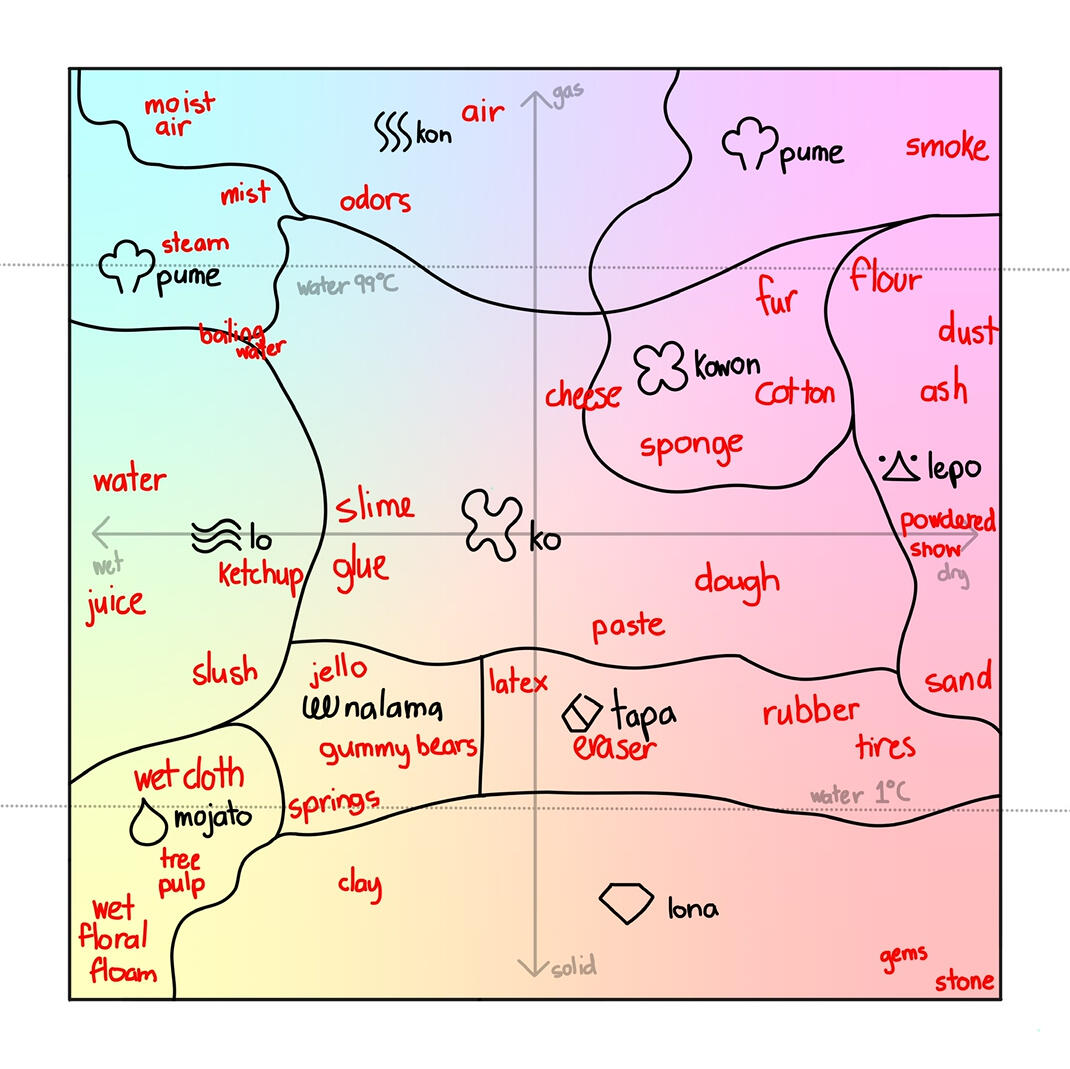
[[BLUE] RED] is PURPLE
Blue-red is purple.CONSISTENCIES.Consistency is the quality of thickness or viscosity in an object. This chart approximately arranges the various consistencies in a grid. Further definitions are underneath.